Calendar Blocking for Solopreneurs (Different Than for Teams)
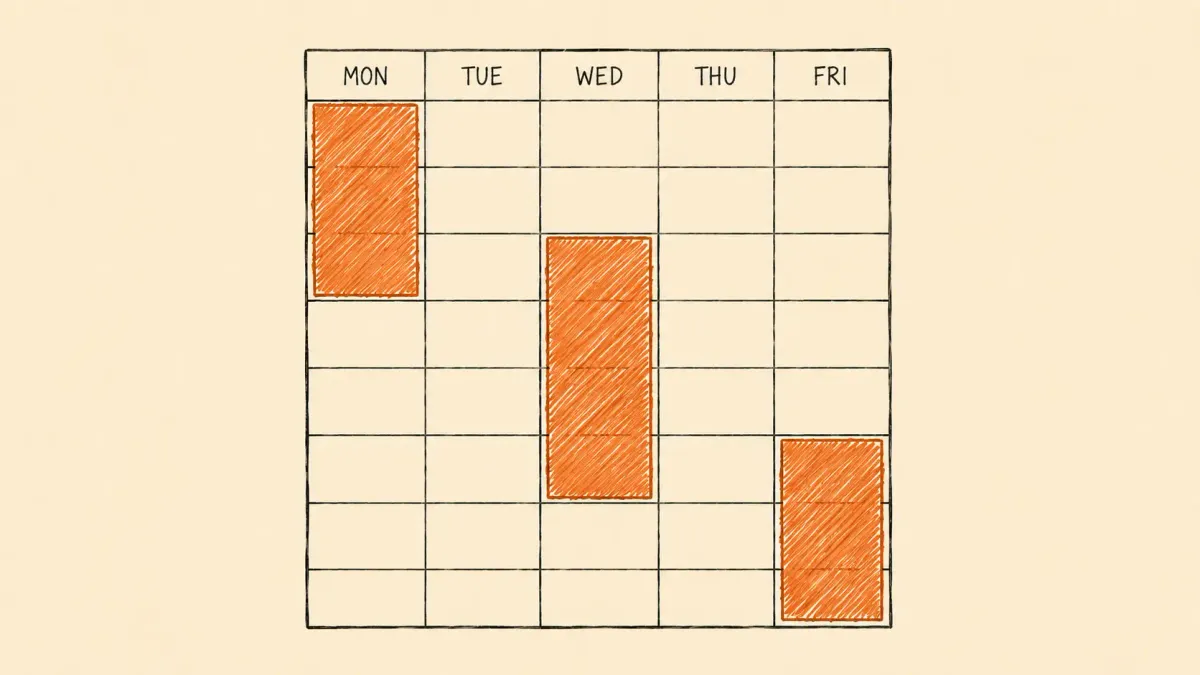
Open any productivity blog and the calendar-blocking advice reads the same. Block 9-11am for deep work. Block 2-3pm for meetings. Block Friday afternoons for “strategic thinking.” It all sounds reasonable until you notice every single one of those articles was written by someone with a manager, a team, and a calendar that other people respect.
Solopreneurs don’t have any of that. There’s no team to defend the block from. There’s no manager whose meeting invite gets priority. There’s just one person trying to do sales, delivery, finance, and admin out of the same skull, with clients who think a calendar block means nothing because they’re paying. The honest framework looks almost opposite to the team version.
Why team calendar-blocking breaks for solo operators
Team calendar advice assumes three things that don’t exist for a solo operator. One: someone else can handle the interruption. Two: the work itself is one type (engineering, design, writing) for big stretches of the day. Three: the calendar is a coordination tool with peers who also follow calendar discipline.
For a solo founder running, say, a Bharuch-based agency with eight clients, none of that holds. The interruption is a WhatsApp from a client who pays ₹40,000 a month and expects an answer in twenty minutes. The work shifts type six times before lunch (proposal, invoice, delivery, sales call, vendor chase, content). The calendar is a personal tool nobody else sees or respects.
So the team trick of “block 9-12 for deep work” doesn’t fail because of laziness. It fails because the underlying conditions for it to work were never present. Importing the rule without importing the conditions produces guilt, not output.
The interruption math is different
A team developer who gets interrupted at 10am loses thirty minutes of context. A solo founder who gets interrupted at 10am might lose the deal, because the interruption was the deal. Solopreneurs can’t treat all interruptions as equal-cost. Some interruptions ARE the work. The framework has to account for that, not pretend it away.
The honest framework: block by energy, not by hour
What actually works for solo operators is a two-axis system. One axis is energy state (sharp, medium, depleted). The other is task category (revenue-creating, revenue-protecting, revenue-killing-if-ignored). Hours barely matter. Most solo founders have roughly four hours of “sharp” per day and burn them on email triage because the calendar told them to.
The honest version of blocking looks like this. Identify the two-to-three hour window where the brain is sharpest. For most people that’s the first window after waking, before any input. Protect that window for ONE thing: the highest-leverage revenue-creating task that week. Not five tasks. One.
The rest of the day gets batched by category, not by clock. All admin in one block. All client calls in one block. All Loom recordings in one block. The order doesn’t matter; the batching does. Context-switching is what kills solo output, and the team-style hour-blocking actually encourages context-switching by pretending each hour is a fresh start.
What “sharp window” actually means
Sharp doesn’t mean caffeinated. It means: capable of holding three variables in working memory while writing, designing, or selling. Most solopreneurs get 3-4 hours of this per day. Some get 90 minutes. Either way, the number is fixed and small, and the entire business depends on what gets done inside it.
If sharp hours go to inbox zero, the business slowly dies even though the calendar looks productive. This is the single biggest leak in solo operations and no team-derived framework addresses it because team frameworks assume the inbox is shared.
The three blocks that actually matter
Forget the fifteen-block color-coded calendar. Three blocks carry 90% of the value for solo operators.
Block one: the maker window. Two to three hours, same time every day, phone in another room, no email open. This block produces the thing that produces money. For a copywriter that’s words. For a designer that’s pixels. For a consultant that’s the deliverable, not the call. This block is the only one that’s genuinely non-negotiable.
Block two: the comms window. Ninety minutes, once or twice a day, where every channel gets checked and answered. Email, WhatsApp, Slack, Instagram DMs. Outside this window, none of them get opened. This sounds extreme to anyone who hasn’t tried it. After a week it feels obvious. The world doesn’t end. Clients adapt. The ones who can’t adapt were going to be problems anyway.
Block three: the admin window. Sixty to ninety minutes for invoices, GST filing prep, expense logging, calendar review, follow-ups. Friday afternoon is the standard slot for a reason: depleted energy is fine for admin, and ending the week with a clean inbox and sent invoices removes Sunday-night dread. Tools like Make.com automation can collapse this block to twenty minutes once the workflows are wired up.
That’s it. Three blocks. Everything else is flex time, walking time, or recovery time, and pretending otherwise creates the fake-productive calendar that solopreneurs are famous for.
The brutal truth about client-facing time
Here’s where team advice does the most damage. Team productivity content treats meetings as a separate, scheduled category. For solo founders, meetings ARE the sales pipeline, the delivery channel, and the relationship maintenance. They can’t be batched into a single Tuesday-afternoon slot the way a team lead batches one-on-ones.
But they also can’t be allowed to colonize the whole week. The fix isn’t blocking; it’s pricing the meeting. Every prospect call eats roughly 90 minutes including prep, the call itself, and the follow-up. If the average deal is worth ₹50,000, that’s a ₹33,000-per-hour activity and worth doing. If the average deal is worth ₹8,000, the math says stop taking calls and switch to written proposals or a structured outreach approach that qualifies harder upfront.
Solopreneurs who burn out almost always took too many calls for too little money. The calendar block didn’t cause the burnout. The unwillingness to refuse the call did. Blocking is a downstream fix for an upstream pricing problem.
Setting meeting days, not meeting blocks
The one team-borrowed habit that does transfer: pick two days a week where calls are allowed, and refuse calls on the other three. Tuesdays and Thursdays work for most. This isn’t really calendar blocking. It’s calendar geography. The point is to leave large unbroken stretches on the other days for actual production work.
Calendly or SavvyCal both let you set this up in five minutes. Make Mondays, Wednesdays, and Fridays invisible for booking. Watch the quality of the maker block triple within a fortnight.
What to stop doing
A few habits, lifted from team productivity culture, that quietly destroy solo output:
Color-coding the calendar. Nobody cares but you, and the time spent coding it is time not earning. A monochrome calendar with three block types is more functional than a rainbow with fifteen.
Time-tracking every task. Useful for billing, useless for self-management. Solo operators don’t need a Gantt chart of their own day. They need to know if rent got paid this month.
Buffer blocks between meetings. Teams use these because calendar chaos cascades. Solo operators just need a 10-minute walk and water. Building 30-minute buffers into a 6-hour day removes half the working time for no real benefit.
Sunday planning sessions for the week ahead. The plan rarely survives Tuesday. A 15-minute review every morning beats a 90-minute planning ritual once a week. Less ceremony, more iteration.
The real test of a calendar system
A calendar system is working if three things are true at the end of a normal week. Revenue moved (a proposal sent, a deliverable shipped, a deal closed). Admin didn’t pile up (invoices out, expenses logged, GST data current). And there’s at least one weekday evening where the laptop stayed shut.
If any of those three failed, the calendar isn’t the problem. The work mix is. Solo operators often blame their calendar system when the real issue is that they took on a client who eats 40% of the week for 15% of the revenue, or said yes to a project that doesn’t fit. Calendar blocking is downstream of those decisions and can’t fix them.
The framework, then, is short. One protected maker window. Two communication windows. One admin block. Two meeting days. Everything else is signal that something upstream needs renegotiating, not more granular blocking.
For the systems that make these blocks actually work, see the guides on Notion as a solo CRM and frictionless client onboarding.