Repurposing One Piece of Content Into Ten (The Honest Version)
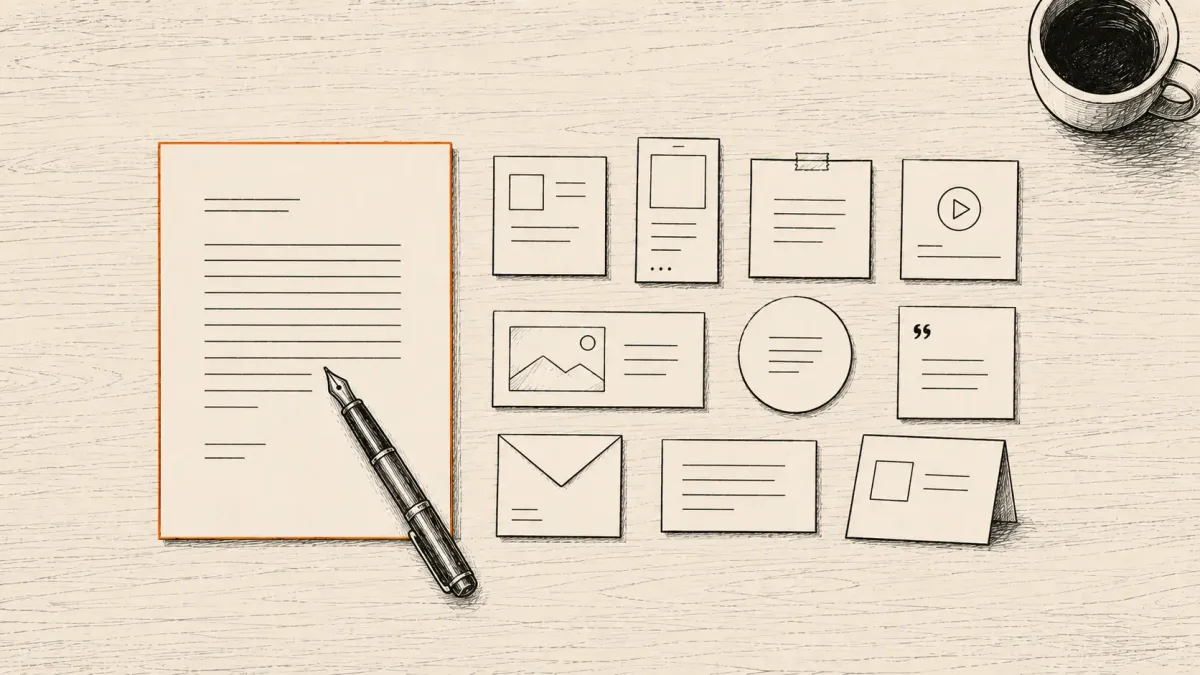
The standard repurposing advice goes like this: write one blog post, slice it into ten tweets, three LinkedIn updates, one carousel, one newsletter, one YouTube short, one Reddit comment. Ten pieces from one. Productivity unlocked.
What you actually get is ten versions of the same paragraph wearing different hats. The tweets are the headers. The LinkedIn post is the intro. The carousel is the bullet points with a gradient background. Anyone who follows you on two platforms sees the same thought twice and unfollows one. The math looked clever. The output is noise.
Why the standard playbook fails
Repurposing isn’t reformatting. The mistake is treating one article as a block of content that needs to be re-cut for each channel. That assumes the article is the unit of value. It isn’t. The unit of value is the insight, the example, the contrarian take, the specific number. A 1,800-word post contains maybe six of those. Maybe four.
If you pull six insights from one post and turn each into one piece on one channel, you get six pieces of genuinely different content. If you also write three meta-pieces (the why, the how, the receipt) and one synthesis piece pointing back to the original, you get ten. None of them overlap. None of them feel like the same thing twice.
The standard playbook tries to multiply the article by ten. The honest version multiplies the ideas inside the article by ten. Different operation entirely.
The extraction pass comes first
Before any repurposing, run an extraction pass on the source piece. Read it cold, two days after writing it, and list every standalone claim. Anything that survives without the surrounding paragraph counts as an extractable unit. Anything that needs context to make sense doesn’t.
Solopreneurs typically find 4-8 of these per long article. A guide on cold email might surface: “subject lines over 7 words drop open rates 30%”, “the first line should not contain the word ‘I’”, “follow-ups outperform first sends 2.4x”, “Tuesday 10am is folklore, the actual best window is Wednesday 6am to 9am local”. Each of those is a complete thought. Each can carry a piece on its own.
The pieces that fail this test (the connecting tissue, the soft transitions, the wrap-up paragraph) shouldn’t be repurposed at all. They were doing a job inside the article. Outside it they’re filler.
Ten pieces, ten different jobs
Here’s the honest framework. Each slot has a distinct purpose and pulls from a different layer of the source piece.
1. The contrarian tweet
Pick the single claim in the article that would make a stranger argue. Strip it to under 240 characters. No thread, no setup. The piece does the work of provoking a reply, which does the work of distribution. Solopreneurs over-thread on X; one sharp claim outperforms eight ramped-up ones.
2. The receipts thread
A different tweet, days later, that backs up the contrarian claim with the specific data, screenshot, or example from the article. This is for the people who saw the first one and want proof. Two tweets, same idea, different audiences.
3. The LinkedIn personal-angle post
LinkedIn rewards a story arc, not a claim. Take one example from the article (a client situation, a moment a process broke, a number that surprised) and rebuild it as a 6-paragraph narrative ending with the insight. The blog post had the insight in the second paragraph. The LinkedIn version saves it for the last line. Same idea, completely different shape.
4. The Reddit answer
Find a thread on r/Entrepreneur, r/freelance, or a niche sub where someone is asking the exact question your article answers. Write a 4-paragraph reply that uses the article’s framework but applied to their specific situation. Link the article only if it adds something the comment couldn’t fit. This isn’t repurposing the article; it’s repurposing the thinking.
5. The newsletter blurb
A 150-word section in the next newsletter that frames the article’s main idea as a recommendation, not a summary. “If you’ve been struggling with X, the move is Y because Z.” Link to the article for the full argument. Readers who don’t click still got the takeaway.
6. The teardown post
Pick one tool or workflow mentioned in passing in the article and write a separate 600-word piece going deep on it. The article mentioned Razorpay for Indian payments in one sentence; the teardown is “Razorpay vs Stripe for ₹10L-₹50L solopreneur revenue, fees breakdown”. Same source DNA, completely independent piece.
7. The counter-take
A piece where you argue against your own article. Not for engagement bait; because every framework has edge cases. “The cold email rules in [original article] break down when you’re selling to procurement teams over ₹5L deals.” Honest, useful, builds trust faster than a victory lap. Few solopreneurs do this and it’s why most content feels hollow.
8. The how-to video or Loom
The article tells you what to do. The 4-minute Loom shows you doing it. Screen-record the actual workflow (the Notion template, the Make.com scenario, the Stripe dashboard setup). The article and the Loom share zero sentences but live in the same conceptual home. For deeper context on screen-recording tools, see Loom vs Fathom for solo client communication.
9. The meta-post about the process
Write about why the original article exists. What prompted it. What you got wrong in the first draft. What a client said that changed the framing. This piece sells the original article without summarizing it, and gives the audience a reason to read the source rather than just the highlights.
10. The synthesis 90 days later
Three months after the original, write the follow-up. What held up. What didn’t. What changed in the market (a tool got acquired, a rate shifted, a platform algorithm flipped). This isn’t a repurpose; it’s a sequel. It makes the original feel like part of a body of work instead of a one-off.
What makes this different from the standard advice
Three things.
First, no piece is a sub-format of another. The tweet isn’t the headline. The carousel isn’t the bullet points. Each piece does a job the others can’t.
Second, the channels carry different weight. The newsletter blurb is for warm audience. The Reddit answer is for cold strangers searching for help. The contrarian tweet is for the algorithm. Matching channel to job kills the “same thought twice” problem.
Third, the work isn’t faster. The standard playbook sold itself on speed: write once, ship ten times. The honest version takes longer because each piece needs its own angle. But solopreneurs aren’t competing on volume; they’re competing on signal. Ten pieces of signal in a month outperforms forty pieces of noise. This is the same compounding logic behind the zero-dollar AI stack for solopreneurs: fewer tools, used deeper, beat more tools used shallow.
The pieces to cut
Some of the ten pieces in the standard playbook should never get made.
The Instagram carousel of bullet points from the article. Skip it. It performs because it’s eye candy, not because anyone takes action from it. Solopreneurs don’t have audiences on Instagram large enough for the format to compound, and the time cost is high.
The YouTube short that’s just you reading the intro. Skip it. Talking-head shorts work for personalities, not for solo operators selling services. The ROI doesn’t exist below 50k subscribers.
The Pinterest pin, the Threads cross-post, the Mastodon mirror. Skip all of them. Each channel multiplies the maintenance cost (replies, DMs, notifications) without multiplying revenue. A piece of content with no audience to reach is a piece of content that didn’t need to exist.
Cutting these is half the framework. The discipline isn’t producing more pieces; it’s refusing to produce pieces that don’t earn their slot.
How to run this in a real week
Block 90 minutes on Monday for the extraction pass on last week’s anchor article. Pull the 4-8 claims. Decide which ten pieces fit (most weeks it’s 7, not 10, and that’s fine).
Block 30-minute slots across Tuesday through Friday for each piece. Single-piece focus per slot. Don’t batch the writing; the pieces share DNA, and batching is what produces the “same thought twice” feel. Different days, different headspace, different angles. Schedule the contrarian tweet, the LinkedIn post, and the newsletter blurb for the same week. Save the teardown, counter-take, and synthesis for later, when the original has had time to breathe.
The unglamorous truth: a solo operator running this honestly produces 6-8 strong pieces per anchor article instead of ten weak ones. That’s the trade. Volume goes down, retention goes up. The audience starts to feel like there’s a person on the other side with a real point of view, not a content factory recycling its own backwash.
For the operational side of running this without burning out, pair this with automating Friday admin in Make.com and the seven mistakes first-year solopreneurs make.