How to Build a Monday Morning Routine That Doesn't Suck

Sunday night dread isn’t a character flaw. It’s a signal that the Monday ahead has no shape, and the brain knows it. Most solopreneur advice treats this with cold plunges, 4:47am wakeups, and gratitude journals shot on a Sony A7IV. None of that fixes the underlying problem, which is that Monday has been left to design itself.
The honest version is simpler and uglier. A Monday routine that works isn’t built around energy or aesthetics. It’s built around removing the three things that actually derail a solo week: decision fatigue before noon, inbox-driven priorities, and the trap of “warming up” with low-stakes admin until the day is gone.
The Sunday 20-minute setup is the routine
Here’s the part nobody on LinkedIn admits. The Monday morning that doesn’t suck is built on Sunday evening, between roughly 6pm and 6:20pm. Twenty minutes. Not a planning ritual. Not a weekly review with seven tabs open. Just a short, boring scan that takes Monday from “what should I work on” to “this is what I’m doing first.”
Three things go on that list:
- The single revenue-moving task for the week (one client deliverable, one outreach batch, one product ship)
- The first 90-minute block on Monday morning, named specifically (not “work on website” but “write homepage hero + first two sections”)
- The two meetings or calls already scheduled, with prep notes pre-written
That’s the whole document. It lives in a single note. Notion, Apple Notes, a paper card stuck to the monitor. Tool doesn’t matter. What matters is that Monday at 9am, there’s nothing to decide. The decision was made by tired-Sunday-you, which is fine because tired-Sunday-you has more context than rushed-Monday-you.
Why this beats the “Sunday weekly review”
The classic GTD-style weekly review is 90 minutes and includes processing every inbox, reviewing every project, and reading the someday/maybe list. For a solo operator running two or three things, this is overkill that quietly becomes avoidance. Twenty minutes of “what’s the one thing” outperforms 90 minutes of “let me look at everything” because the second one rarely ships and the first one always does.
If a longer review is genuinely needed, do it Friday at 4pm, not Sunday. Sunday’s job is to protect Monday’s first hour, nothing more.
The first 90 minutes have one rule: no inputs
The biggest lie sold by morning-routine content is that Monday should start with intake. Read the news. Check Slack. Triage email. “Get a sense of what’s happening.” This is how seven hours disappear into reacting to other people’s priorities while the actual revenue-moving work waits until Tuesday, then Wednesday, then never.
The rule is brutally simple. From whatever time the workday starts until 90 minutes later, no Slack, no email, no WhatsApp, no Twitter, no Substack, no Telegram, no client portals. The phone goes face-down across the room or in a drawer. The browser opens to exactly one tab: the work named on Sunday’s note.
For solopreneurs in India running on Bharat-time inboxes (clients pinging at 8am, distributors WhatsApping at 8:30, GST portal nags), this is harder than it sounds. The workaround is a single auto-reply on WhatsApp Business that says “responding to messages after 11am, urgent calls go to [number].” Most things aren’t urgent. Almost nothing dies in two hours.
The 90-minute block isn’t sacred because of some neuroscience claim about ultradian rhythms. It’s sacred because it’s the only window of the day where attention is genuinely uncontested. Once 10:30am hits, the day belongs partially to other people. Before that, it belongs entirely to the work that pays.
Stop trying to “win” the morning
The performative version of solopreneur Mondays involves a 5am wakeup, 45 minutes of mobility work, a cold shower, journaling, meditation, and a protein smoothie before the laptop opens. By 9am the person is exhausted, virtuous, and has produced zero billable output. This is a hobby, not a routine.
The functional version is much less photogenic:
- Wake up at a sustainable hour (whatever lets you sleep 7+ hours, end of debate)
- Coffee or tea, water, whatever the body wants
- Skip the phone for the first 30 minutes (this one matters)
- Sit down at the desk by a fixed time, give or take 15 minutes
- Open the Sunday note
- Start
That’s it. No journaling required. No mantras. No habit-stacking pyramid. The energy spent optimizing the pre-work routine is energy not spent on the work itself, and for a solo operator that math never balances.
The only pre-work habit worth defending is the phone-free first 30 minutes. Not because of dopamine theory or attention research, but because the first input of the day sets the emotional baseline for the next four hours. Starting with a client complaint, a payment delay, or a competitor’s launch announcement guarantees a worse Monday than starting with nothing.
The exception that’s allowed
One short walk before sitting down works for a lot of people. Ten to fifteen minutes outside, no phone, no podcast. This isn’t a fitness routine. It’s a context-switch from “home” to “work” for someone whose office is twelve feet from their bed. Skip it if it feels forced. Keep it if it actually helps the first 90 minutes land.
Monday meetings are the silent killer
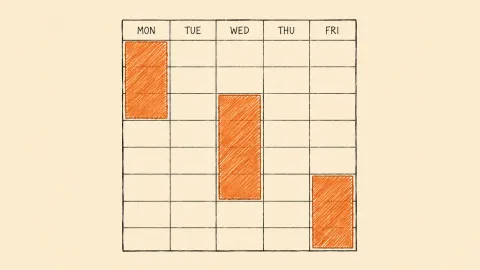
Here’s an opinion that gets pushback: no client calls before 12pm on Monday. None. Discovery calls, check-ins, kickoffs, “quick syncs”, all of it pushed to Tuesday through Thursday afternoons. Friday afternoon stays clear for Friday admin automation and weekly wrap.
The reasoning is straightforward. A 30-minute call at 10am doesn’t cost 30 minutes. It costs the 90-minute deep block on either side of it, because the brain spends the hour before getting ready and the hour after recovering. One Monday morning call effectively burns the entire morning’s revenue-moving window.
Clients adapt fast when the calendar simply doesn’t show Monday slots. Calendly, Cal.com, SavvyCal, all of them let you blank out Mondays in 30 seconds. The booking page shows Tuesday through Thursday. Nobody asks why. The few clients who push back (“can we do Monday 9am?”) are usually the same clients who’ll push back on every boundary, which is its own useful filter and connects to the bad-client warning signs worth watching for.
If a recurring Monday standup is non-negotiable because of a retainer client, move it to 2pm. The morning stays protected. The standup becomes the bridge into afternoon shallow work, which is where it belonged the whole time.
What Monday actually produces
If the routine works, Monday ends with three things done:
- One revenue-moving task fully shipped or meaningfully advanced (not “worked on”)
- Inbox triaged once, at 11am, in a single 20-minute pass
- A clear Tuesday-morning block named in the same Sunday-style note, written before logging off
That’s the whole scorecard. No streak counts. No habit grid. No “deep work hours logged” in a spreadsheet. Either the revenue task moved or it didn’t. The week’s momentum compounds from there or it doesn’t.
Solopreneurs running across multiple products (a service business plus a SaaS, or a content site plus client work) need one more rule: Monday gets assigned to one of them, not both. Splitting Monday across two businesses is how neither one ships. Pick the one with the closest revenue event (an invoice, a launch, a deadline) and Monday belongs to it entirely. The other business gets Wednesday.
The version that actually fits your week
The routine above isn’t a template to copy verbatim. It’s a frame with four load-bearing pieces: the Sunday 20-minute note, the 90-minute no-inputs morning block, the phone-free first 30 minutes, and the no-Monday-meetings rule. Everything else is decoration.
If only one piece is implemented, make it the Sunday note. Twenty minutes on Sunday evening will outperform any 5am wakeup, any meditation app, any productivity stack from a Twitter thread. The compounding effect over a quarter is large, and the cost is one Netflix episode skipped each week.
The reason most Monday routines suck isn’t laziness or lack of discipline. It’s that they were designed for someone with a manager, a team, and an external structure that holds the week together. Solo operators have to build that structure themselves, and the place it starts is a boring twenty-minute note on Sunday evening. Not glamorous. Not photogenic. Just the thing that works.
For the operational layer that protects this routine, see how Friday admin gets automated end-to-end and which browser extensions cut the small daily friction that erodes Monday’s first 90 minutes.