GST Registration for Indian Solopreneurs (The Actually-Useful Guide)
Walk into any CA’s office in Bharuch, Surat, or Bengaluru with a question about GST registration and the answer arrives before the question finishes. Register. Always register. File monthly. Pay our retainer.
That’s wrong for most solopreneurs. The actual GST decision in 2026 hinges on three numbers, one client type, and one platform choice. Everything else is noise sold by tax SaaS companies and CAs who bill by the return.
The threshold that actually matters (and the one that doesn’t)
The headline number every blog repeats is ₹20 lakh. Cross ₹20 lakh in annual turnover and registration becomes mandatory. For special category states it’s ₹10 lakh. For pure goods supply it’s ₹40 lakh.
Most solopreneurs reading this will never hit ₹20 lakh in their first two years. A freelance designer charging ₹50,000 per project needs forty projects a year to cross it. A consultant on ₹75,000 monthly retainers needs more than two simultaneous clients sustained for twelve months. The threshold is real, but it isn’t the trigger that forces most registrations.
The trigger that actually forces it: interstate supply of services. Sell a logo design from Gujarat to a client in Karnataka and technically you’ve made an interstate supply. The 2017 law made this an automatic registration trigger regardless of turnover. In 2019 the government carved out an exemption: service providers under ₹20 lakh don’t need to register for interstate supply either. That carve-out still holds in 2026. Goods sellers don’t get it. If you ship physical products across state lines, register from rupee one.
So the honest threshold rule for a service solopreneur:
- Selling services only, under ₹20 lakh: registration is optional
- Selling services across borders to foreign clients, under ₹20 lakh: still optional, but read the export section below
- Selling physical goods interstate: register immediately
- Crossed ₹20 lakh in the previous financial year: register within 30 days
Why most solopreneurs register anyway (and why three of those reasons are bad)
The pressure to register early comes from four places. Three are weak.
Reason 1: The client demanded a GST invoice. This is the only good reason to register early. Indian B2B clients above ₹5 crore turnover want input tax credit. If they can’t claim ITC on your invoice, your effective price is 18 percent higher to them than a registered competitor’s. Lose enough deals to that math and the cost of registration starts to look small. Test this before assuming it. Ask the actual prospect: “Do you need a GST invoice?” Most ₹2-10 crore SMBs don’t push hard if your work is good.
Reason 2: It looks professional. It doesn’t. A GSTIN on an invoice is invisible to 90 percent of clients. The ones who care are the ones already covered by reason 1.
Reason 3: The CA said so. CAs earn ₹1,500-3,000 per month per GST client on filings. Their incentive is registration. This isn’t villainous, but it isn’t aligned with a ₹4 lakh per year solopreneur either.
Reason 4: “I’ll cross the threshold soon.” Maybe. Track turnover quarterly. If Q1 plus Q2 puts you on pace to cross ₹15 lakh by year-end, then start the registration process in Q3. Pre-registering “to be safe” creates compliance overhead the business hasn’t earned. The same thinking that traps solopreneurs into premium tools they can’t justify yet applies here.
The composition scheme trap
Tax SaaS sellers push the composition scheme hard at small service providers. The pitch: pay 6 percent flat on turnover, file quarterly instead of monthly, less paperwork.
The catch nobody mentions on the landing page:
- You cannot claim input tax credit on anything you buy
- You cannot issue tax invoices, only bills of supply
- Your B2B clients cannot claim ITC on what they pay you
- You cannot make interstate supplies at all
- The 6 percent is paid out of your own pocket, not collected from the client
For a Gujarat-based content writer with three Mumbai clients and a Razorpay subscription, composition scheme is worse than not registering and worse than regular registration. It only makes sense for a hyperlocal service provider with all-cash B2C clients in one state who genuinely wants the flat-rate simplicity. That describes about 5 percent of the people who get sold it.
Export of services: the section every freelancer should read
This is where the actual money lives for solopreneurs serving foreign clients, and where the misinformation is thickest.
Selling services to a client outside India, with payment in foreign currency through a recognised channel (Wise, Stripe, Razorpay International, bank wire), can qualify as export of services. Export of services is zero-rated under GST. Zero-rated means GST applies but at 0 percent, and any input tax credit on Indian expenses (laptops, software, SaaS subscriptions, co-working memberships) becomes refundable.
A solopreneur billing $4,000 monthly to a US client, registered for GST with an LUT (Letter of Undertaking) on file, pays zero GST on those invoices and can claim refunds on ₹1.5-2 lakh of annual ITC. That’s ₹25,000-40,000 a year recovered that an unregistered freelancer simply loses.
The catch: the LUT must be filed at the start of every financial year, and the FIRC (Foreign Inward Remittance Certificate) or equivalent must match each invoice. Wise and Razorpay International issue these automatically now. PayPal and direct bank wires require pulling the certificate from the bank. For more on which payment rail to choose, the breakdown in the Stripe vs Razorpay vs Wise comparison covers the FIRC angle in detail.
For an export-only freelancer below ₹20 lakh, registration is optional but financially smart. Above ₹20 lakh, it’s mandatory and still financially smart.
The actual registration process in 2026
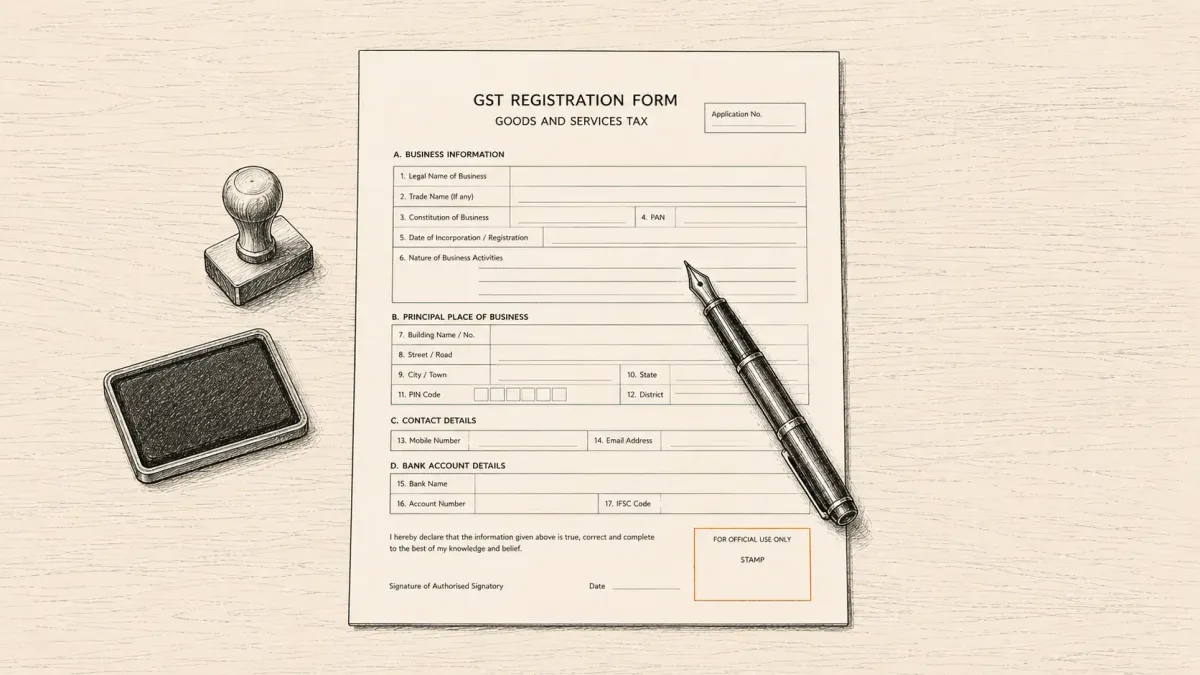
Skip the CA for the first registration unless turnover is already complex. The portal at gst.gov.in handles it in 40-60 minutes if documents are ready.
What’s needed:
- PAN of the proprietor
- Aadhaar linked to the PAN
- Photograph of the proprietor (JPEG, under 100 KB)
- Proof of place of business (rent agreement plus electricity bill, or property tax receipt for owned premises)
- Bank account proof (cancelled cheque or first page of passbook)
- Mobile number and email matched to the Aadhaar for OTP verification
The process: New Registration on the portal, fill Part A (PAN, mobile, email), receive TRN (Temporary Reference Number), complete Part B (business details, place of business, bank, authorised signatory, verification), submit with Aadhaar e-KYC. Approval lands in 3-7 working days for clean applications. Anything flagged goes to physical verification and takes 30+ days.
Two common failures: the rent agreement is in someone else’s name (a parent, a spouse) and no NoC is uploaded; or the bank account name doesn’t exactly match the proprietor’s PAN name. Fix both before submitting.
What changes after registration
Monthly returns become the new background task. GSTR-1 by the 11th, GSTR-3B by the 20th. Annual return GSTR-9 if turnover exceeds ₹2 crore. Late fees are ₹50 per day per return, capped but painful.
Three tools handle this for a solopreneur without hiring a CA:
- ClearTax GST: ₹2,499 per year, good UI, auto-imports from Tally and Excel
- Zoho Books with GST module: ₹749 per month, integrated invoicing plus filing
- TallyPrime with GST: one-time license around ₹22,500, the choice if there are inventory or multiple business lines
For a pure service freelancer, ClearTax is the default. For a product-and-service mix, Zoho Books pays for itself in invoice automation. Folding the monthly return into a standing Friday admin block turns it from a recurring panic into 20 minutes of clicking.
When to bring in a CA anyway
Three situations justify the ₹1,500-3,000 monthly retainer:
- Mixed turnover above ₹50 lakh with both export and domestic clients (the ITC reconciliation gets messy)
- Notices from the department (never reply to a GST notice without a CA reading it first)
- Switching from proprietorship to LLP or Pvt Ltd, which usually means a fresh GSTIN under the new entity
Outside these, the monthly retainer is paying someone to click File on a return the solopreneur could file in 15 minutes. Most CAs will admit this if pressed.
The honest decision tree
Strip out the noise and the registration question becomes four checks in order.
Are you selling physical goods across state borders? Register now. Are your B2B clients explicitly asking for GST invoices and walking away when you can’t issue one? Register now. Are you exporting services and want the ITC refund on Indian expenses? Register now, file an LUT, set up ClearTax. Is none of the above true and turnover is under ₹15 lakh with a realistic year-end projection below ₹20 lakh? Don’t register yet. Track turnover quarterly. Revisit when one of the first three conditions changes.
The cost of registering too early is ₹30,000-50,000 a year in tools, time, and mental overhead on a business that may not survive the first year. The cost of registering too late is a one-time late fee and back-payment of tax on turnover above the threshold, neither of which is fatal. Asymmetric downside favors waiting.
For more on the financial setup that pairs with this, the breakdown of Indian payment rails for solo founders and the post on common first-year solopreneur mistakes cover the adjacent decisions worth getting right early.