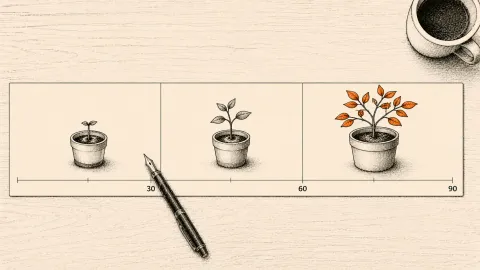
Deep Work Blocks When You Have No Boss (The Realistic Version)
Cal Newport’s Deep Work sold 750,000+ copies on a quiet assumption nobody talks about. The reader has a job. There’s a calendar with meetings on it, a Slack channel that goes quiet at 6pm, a manager who notices output. The deep work block fits inside a container someone else built.
Solopreneurs don’t have that container. Nobody books the meeting that ends the block. Nobody notices if Tuesday morning gets swallowed by inbox triage and a Razorpay reconciliation that didn’t need doing today. The framework still works, but the scaffolding has to be rebuilt from scratch, and most of the productivity advice floating around for freelancers just copies the original without admitting the load-bearing piece is missing.
The boss-shaped hole in the framework
The original framework leans on three external forces: a calendar with non-negotiable meetings, social pressure from coworkers, and a paycheque that arrives whether or not Tuesday felt productive. Remove all three and the block becomes optional. Optional blocks don’t happen.
Solopreneurs who try to install a 90-minute morning block usually fail in the same way. Day one feels great. Day three, a client email arrives at 8:55am and the block gets “just delayed” to 10am. Day five, it gets moved to “after lunch.” Day eight, the block is a memory and the calendar has a new colour-coded system on it instead. The system replaces the practice. This is procrastination dressed as planning, and it’s the default state of every solo operator who reads productivity books.
The honest version of deep work for solopreneurs isn’t about willpower or better calendars. It’s about replacing the missing external forces with internal ones that are cheap, specific, and don’t depend on motivation. There are three that actually hold.
Replace the boss with a paying deadline
The single most reliable enforcer of a deep work block is money already in escrow. Not a vague invoice. A signed scope with a delivery date and 50% upfront sitting in the bank account.
A freelancer with ₹40,000 of a ₹80,000 project already paid, and a Friday deadline written into a contract, will find the 90 minutes. The block enforces itself because the alternative is refunding money or shipping garbage. The scarcity is real. Newport’s professor protagonists had tenure committees doing this job; solopreneurs have to manufacture the equivalent by stacking deadlines tighter than feels comfortable.
The practical version: never quote a deadline more than 10 working days out for any single deliverable. If a project is bigger, break it into three pieces with three deadlines. Each piece is now a forcing function. The deep work block becomes the only path between Monday morning and Friday’s deliverable, and “I didn’t feel like it” stops being an available answer.
This is also why retainer-only solopreneurs burn out on deep work fastest. The money arrives on the 1st regardless of what got shipped, the deadline pressure dissolves, and the block becomes optional again. A healthy practice mixes retainer income for the floor and fixed-scope projects for the deep work forcing function.
The 90-minute morning lie
Most productivity content for solopreneurs prescribes a 90-minute deep work block, ideally in the morning, ideally before email. This is wrong for at least 60% of the people reading it.
Solopreneurs aren’t all knowledge workers writing essays. A developer building a feature needs 3-4 hour stretches because the context cost of getting back into the codebase is brutal. A designer iterating on a brand identity needs maybe 45 minutes of actual deep work bracketed by 2 hours of looser exploration. A consultant writing a strategy memo can genuinely deliver in 75 focused minutes. The right block length is downstream of the actual work, not borrowed from a book.
The morning timing assumption is the other lie. Morning works for people whose nervous system is calm in the morning. For a solopreneur running B2B sales in India where WhatsApp pings start at 9am and don’t stop until 8pm, the only block of silence is often 9pm to midnight, and pretending otherwise just guarantees the block never lands. The right time to schedule deep work is the window where the phone is statistically quietest, not the window a Cal Newport reader fantasizes about.
Audit, then commit
Before installing any block, run a one-week audit. Note every interruption: when it came, what channel, who from, whether it was urgent. By Friday, the actual quiet window is visible in the data. That’s where the block goes. Not where it “should” go.
This audit also surfaces the second problem nobody admits: most solopreneur interruptions are self-inflicted. The phone wasn’t pinging; the operator picked it up. A browser extension stack that blocks the right tabs handles 70% of this without willpower involved. Cold Turkey, Freedom, or even just a separate Chrome profile with no logins. Cheap fixes, massive return.
Build the missing accountability layer
The third missing piece is social. Newport’s office workers had peers walking past. Solo operators have nobody, and “internal accountability” is a polite phrase for “didn’t happen.”
The fix isn’t a coach (too expensive, too slow) or a mastermind group (mostly performance). The fix is structural: one other person who sees the output, on a fixed schedule, with a real consequence for missing.
Three formats that hold up over six months or more:
The Monday/Friday pair. One other solopreneur, a 15-minute call Monday morning where each names the one shippable thing for the week, and a 10-minute call Friday afternoon where each reports the result. No coaching, no discussion. Just witness. The format is brutal because there’s no way to fudge “did the thing or didn’t.”
The deposit forfeit. ₹5,000 sitting with a friend, released only on proof of delivery. Stickk.com runs this digitally with charity forfeits but for solopreneurs, a real human holding real money works better. The amount has to sting; ₹500 doesn’t.
The public log. A single Notion page, public URL, updated every Friday with the week’s deliverable. One client or peer watches it. The audience is small, but the page exists, and the gap between “promised” and “shipped” becomes visible to someone who isn’t the operator.
The instinct to skip this layer is the strongest predictor of failure. Solopreneurs who say “I work better alone” are usually saying “I haven’t shipped consistently in 18 months.” Pick a format, install it this week, and accept that the discomfort of being watched is the price of the structure.
What an actual week looks like
The honest schedule for a solo operator running both client work and product development isn’t four-hour morning blocks every day. It’s something messier and more sustainable.
Two deep work blocks per week, 3-4 hours each, on the two days the calendar is structurally clean (no client calls, no recurring obligations). For most India-based solopreneurs that’s Tuesday and Thursday, because Monday is catch-up and Friday is admin. These blocks are protected with the same energy a meeting with a paying client would get. Phone in another room. Calendar shows “unavailable.” Friday admin gets automated into a 90-minute window so it stops bleeding into the rest of the week.
The other three weekdays run on shallow work, client calls, and shipping the smaller pieces of the deep work output. Email checked twice. WhatsApp answered in batches at 11am, 3pm, and 7pm. Not aspirational; actually doable.
The weekly deliverable gets named on Monday, witnessed by one other person, and shipped by Friday whether or not it’s perfect. Ship before polish is the constraint. Two deep blocks plus a forcing function plus a witness equals roughly 80% of what Newport’s framework promises, adapted for the structural reality that nobody is enforcing any of it except the operator.
The version that survives month six
Most deep work systems collapse around week four. The novelty wears off, a client crisis breaks the rhythm, and the calendar slowly fills back up with shallow work because shallow work feels productive and rarely fails publicly.
The version that survives past month six has three properties: the block length matches the actual work (not a book), the timing matches the actual quiet window (not a fantasy), and an external witness sees the output every Friday (not “internal discipline”). Strip away any one of these and the system degrades within a month. Keep all three and it compounds.
The uncomfortable truth is that deep work for solopreneurs is 20% technique and 80% scaffolding. The technique is in every productivity book. The scaffolding is what nobody writes about because it’s specific, social, and slightly embarrassing to admit needing. Build the scaffolding first. The block will install itself.
For more on the structural side of running solo, see the seven mistakes most first-year solopreneurs make and the zero-dollar AI stack that handles the shallow work so the deep blocks stay clean.