The Bulk AI Output Trap (Why Asking Claude for 36 of Anything Drifts at #14)
I asked Claude to write 36 image prompts in one go yesterday. They needed to follow a specific discipline. Each prompt had to include a viewing angle, a grounded surface, three to five named objects, one partial-visibility edge element, and a tight orange accent. The first ten came back clean. The next four were noticeably looser. By prompt #14, the discipline was gone. By #20, every prompt was the same flat icon on a white background.
I caught it because I re-read every single one. If I had not, I would have shipped 22 prompts that did not match the brand and discovered the drift only when the images came back wrong, two weeks and one batch generation later. The lesson is not “Claude is bad at bulk work.” The lesson is that bulk AI output looks like a productivity win and is in fact a hidden tax, and most solo founders pay it without noticing.
This piece is about the drift pattern, the mechanism behind it, and the three rules that actually catch it before it eats your day.
What the drift looks like in practice
The pattern is consistent across every bulk-output task I have run through any current LLM. Whether it is image prompts, blog outlines, product descriptions, cold email variants, or social posts, the same shape emerges:
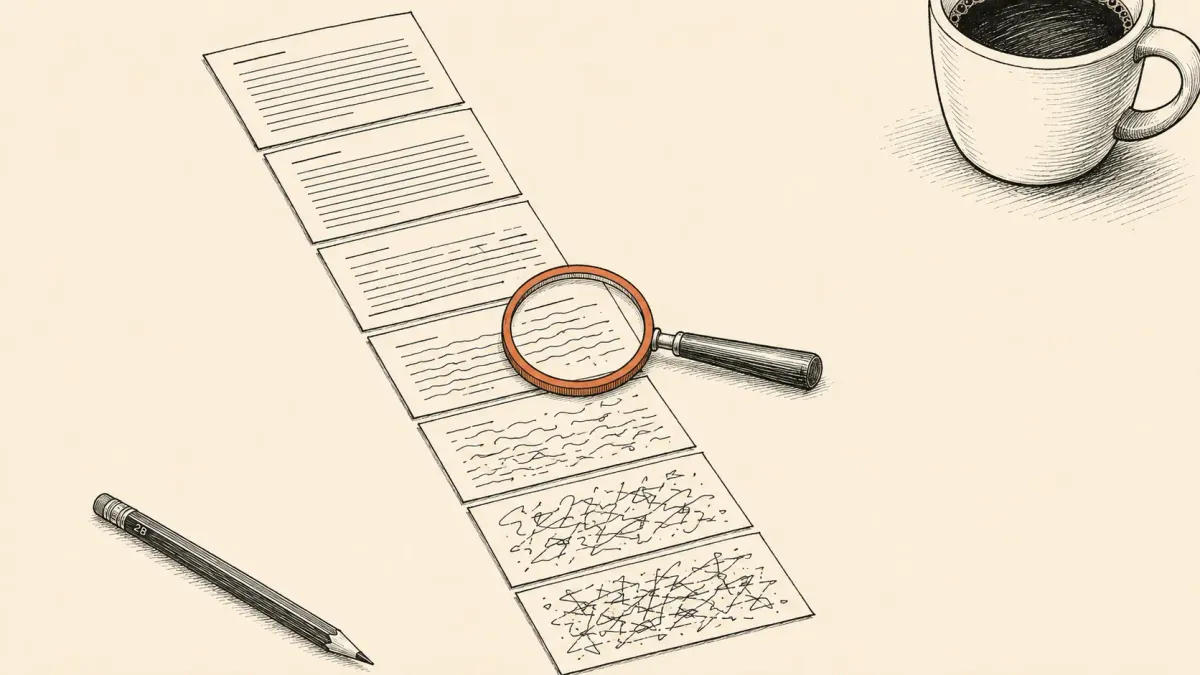
Items 1 to 5. Crisp. On-brief. Every constraint honored. Often the best work the model is going to produce in this batch.
Items 6 to 10. Still solid. Maybe one or two start to feel slightly templated, but the discipline is intact.
Items 11 to 15. The first real cracks. Subtle dropping of specific constraints. The output starts to feel like the model is interpolating rather than thinking. You will notice it if you read carefully. You will not notice it if you skim.
Items 16 to 25. Full drift. The model has fallen into a comfortable groove that satisfies the surface form of the brief but not the substance. Specific named objects become “various items.” Distinct viewing angles collapse into “a tabletop.” Brand-specific accent rules are quietly dropped.
Items 26 to 36. Either a return to the first-five pattern (because the model has “reset” by losing context coherence) or full bland baseline output. Sometimes both, in the same batch.
The reason this is dangerous is that the early items train you to trust the output. If you read prompt 1 through 5 and they all look right, the next 30 get a glance, not a read. The trust the early items earned is then spent on items that did not earn it.
Why this happens (mechanism, not vibes)
Three things are happening at once.
Context attention degrades over long generations. Every token the model writes pushes the original constraints further back in its working memory. By item 20, the original brief is hundreds of lines back. The model is now attending mostly to the items it just produced, which means it is now copying its own recent pattern rather than the original spec. Reinforcement of recent output is mechanically built into how transformer attention works at long generation length.
Constraint compression. Models do not represent the brief as a checklist. They compress it into a “vibe” that gets thinner as the conversation extends. The vibe converges on the average of what has been produced so far, which means an early loose item poisons the next ten.
Optimization for fluency, not faithfulness. All current LLMs are optimized to produce smooth, coherent prose. When the original brief conflicts with smoothness (because the brief is unusual, brand-specific, or has many simultaneous constraints), the model quietly favors smoothness. You see this most dramatically in image prompts, where “tight orange accent on the third object from the left” gets dropped because it is awkward, and “warm color palette” appears in its place because it is smoother.
None of these failures are bugs. They are properties of how the technology works at scale. Expecting Claude or GPT-5 or any successor to not drift on a 36-item batch is expecting the model to violate its own architecture.
The three rules that actually catch it
I have lost enough hours to this pattern that the rules below are now muscle memory.
Rule 1: Never ship a bulk batch without reading every item. This is the rule that saves you. Twenty minutes of careful reading after a five-minute generation is the actual cost. If you skip the reading because the early items looked good, you are not saving time, you are deferring the cost to the moment the bad output reaches its destination (a client, a published article, a generated image batch).
Rule 2: Batch sizes of 10 or fewer. If you need 36 of something, run four batches of 9, not one batch of 36. Each batch gets its own fresh context window where the brief is still close to the front. The total token spend is slightly higher because you re-send the brief four times. The total quality is dramatically higher because no batch hits the drift zone. For Claude, GPT, and Gemini, 10 is the rough ceiling for consistent on-brief output across the entire batch. Past 10, you are betting on luck.
Rule 3: Spot-check the back half before the front half. This is the counterintuitive one. When you sit down to review a 36-item batch, read items 25, 30, and 35 first. If those look on-brief, the front half almost certainly is. If those look off, you have caught the drift in five minutes instead of an hour. The instinct to start at item 1 is the trap, because item 1 is always good and lulls you into trusting the rest.
Two more habits that pair with these rules.
Re-send the brief between batches. When you are running batches of 10, do not say “do another 10.” Restate the entire brief, including the specific constraints, before each new batch. This forces the model to re-anchor on the original spec instead of riffing on the previous batch.
Mark constraints in your check-list, not just the brief. Before reading the output, write down the specific things each item must contain. Then read each item against the checklist. The brief told the model what to do. The checklist tells you what to verify. They are different documents.
Why this matters more for solo founders than for anyone else
A team can absorb the drift tax. One person reviews the brief. A different person reviews the output. A third person catches the drift in QA. The system has multiple checkpoints by accident.
A solo founder has no such checkpoints. The same brain that wrote the brief is the brain reviewing the output, which means the brain is now anchoring on its own recent expectations, which is the same failure mode the model just experienced. You and the model are now drifting in the same direction.
This is why solo founders especially need batch-size discipline and back-half spot-checks. The natural failure mode (skim the early items, trust the rest, ship) is exactly what the model is hoping you will do. The fix is not motivation or better prompts. The fix is process: smaller batches, back-half first, checklists separate from briefs.
The hours you save by running one 36-item batch instead of four 9-item batches are real. The hours you lose to drift you did not catch are also real, and they tend to be larger, because they compound. A bad image prompt produces a bad image, which costs another generation cycle, which delays a publish, which delays a distribution piece, which delays the first traffic spike.
The bulk-AI workflow that actually works is boring. It is small batches, re-stated briefs, back-half-first reading, and external checklists. None of it is glamorous. All of it saves you from the productivity illusion of “I generated 36 things in five minutes” turning into “I redid 22 of them anyway.”
What changes when you stop trusting the back half
The biggest shift is psychological, not procedural. You stop treating bulk output as “done” the moment it appears. You start treating it as “raw material that needs verification.” That sounds like more work, but it is not. It is the same total work, allocated differently, with the verification step actually catching the problems instead of pretending they do not exist.
The productivity story you get sold (“I 10x my output with AI”) is true if your standard for “output” is total volume. It is false if your standard is total verified output. Most solo founders need the second number, because the first one ships embarrassments that take longer to clean up than they took to produce.
If you only adopt one habit from this piece, make it back-half-first reading. Start at item 25 of every batch and read backwards. The five minutes it takes will save the hour you would have spent on damage control. That five minutes is the actual productivity move. Everything else is theater.
The bulk-AI drift pattern shows up across every workflow that uses AI to generate at scale. If you are building your own AI stack for solo work, the zero-dollar AI stack for solopreneurs lays out the tools without falling for the productivity illusion, and the four AI workflows that pay for themselves covers what bulk output is actually useful for once you accept the drift tax exists.