Async Client Communication: The 3-Channel Framework
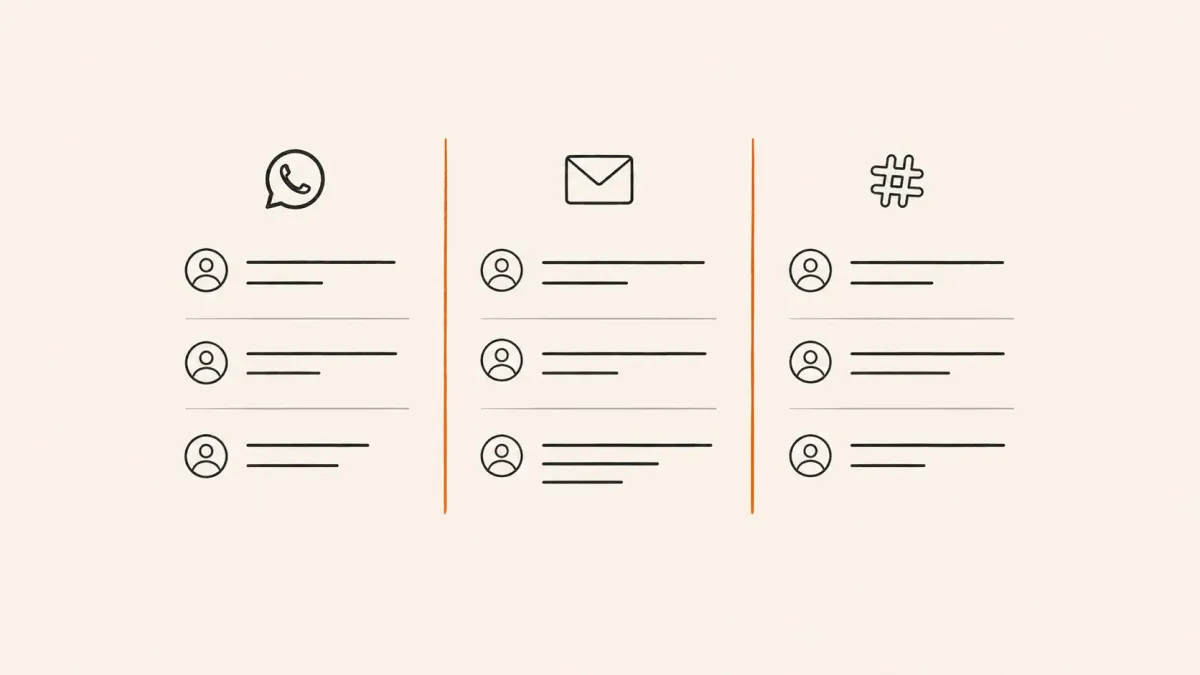
Most solopreneurs treat WhatsApp, email, and Slack as interchangeable inboxes. They aren’t. A client pings on WhatsApp about a billing question, sends a contract amendment over email at 11pm, then drops a Loom in Slack expecting a same-day reply. The freelancer answers all three the same way: quickly, anxiously, and without thinking about which channel was the right one for each request.
The result is predictable. Decisions get buried in WhatsApp threads. Contracts get lost in email chains. Slack becomes a 24/7 panic room. The fix isn’t another productivity app or a stricter “no-notifications” rule. It’s assigning each channel one clear job, telling the client what that job is, and then refusing to use the channel for anything else.
The wrong belief: channel = personal preference
Solopreneurs typically pick channels based on what feels comfortable. WhatsApp because the client is Indian and “everyone uses WhatsApp here.” Email because it feels professional. Slack because a previous agency job normalized it. None of those reasons map to what the channel is actually good at.
WhatsApp is built for immediacy. Notifications are loud, read receipts are visible, voice notes are one-tap. Email is built for documentation. Threads are searchable, attachments persist, the timestamp is legally meaningful. Slack is built for collaboration inside a working session. Channels organize topics, threads keep replies attached, and integrations pipe in data from other tools.
When channels get mixed up, the strengths cancel out. A pricing negotiation on WhatsApp can’t be audited six months later. A “quick question” in email takes three days because the client only checks email twice a week. A contract sent in Slack DM gets buried under a meme from a different client.
The 3-channel framework
The framework assigns one role to each channel. Three roles, three channels, no overlap.
Channel 1: WhatsApp = signal, not substance
WhatsApp is for one thing: telling someone that something needs their attention elsewhere. “Sent you the proposal on email, mind reviewing today?” “Invoice went out, Razorpay link in your inbox.” “Loom is in our Slack, 4 mins, watch before the Thursday call.”
That’s it. No deliverables. No decisions. No price negotiations. No scope changes. The reason is simple: WhatsApp has no structure. Six weeks from now, finding the message where the client agreed to add a second landing page means scrolling through 800 messages including birthday wishes and Diwali greetings.
Solopreneurs working with Indian clients often resist this. The client wants to “just WhatsApp.” Hold the line politely. The reframe that works: “WhatsApp is how I’ll always ping you fast. Email is where the actual work lives so neither of us loses it.” Most clients accept this within the first project because they’ve also lost things in WhatsApp.
One exception: voice notes for vibe-checks and rapport. A 30-second voice note saying “loved the brand direction, let’s go” is fine. A 4-minute voice note explaining a revised scope is not. If it took 4 minutes to say, it needs to be written down.
Channel 2: Email = the contract layer
Email is where anything with money, scope, or legal weight lives. Proposals. Invoices. Contracts. Scope changes. Project kickoff summaries. Final deliverables. Anything that a future version of either party might need to reference in a dispute.
The discipline is treating every email as if it might be exhibit A. Subject lines are specific (“Acme Co, Brand Sprint Proposal v2”) not vague (“Following up”). Bullet points, not walls of text. A “what I’m waiting on from you” line at the bottom of every email so the ball is never ambiguous.
For solo operators billing internationally, this matters more than for agencies. There’s no account manager to reconstruct decisions later. If a US client disputes a ₹2.5L invoice, the only record is what’s in email. WhatsApp screenshots don’t carry the same weight, and Slack history might be gone if the workspace was on a free plan and aged out.
A useful pattern: end every client call with a 6-line recap email within 60 minutes. “Here’s what we decided, here’s what I’m doing next, here’s what you’re sending me by Friday.” This single habit prevents 80% of “I thought we agreed…” conflicts. Tools like Fathom handle the transcript, but the recap email is still a human-written summary because that’s what gives it legal and emotional weight.
Channel 3: Slack = the working surface
Slack (or Teams, or a shared Notion, or whatever the client uses) is the working surface during an active engagement. Day-to-day questions. File handoffs in progress. Quick feedback loops. Sharing a Loom. Pinging that a draft is ready for review.
The role is different from email because the audience is different. Email is the client’s decision-maker, often a founder or marketing head who checks twice a day. Slack is the operating team, often a mix of in-house staff and other contractors, who live there 9 hours a day. Slack is where the work breathes.
The trap solopreneurs fall into: making Slack the contract layer too. Approving a price change in Slack. Confirming a deliverable scope in a Slack thread. Six months later when the engagement ends and the workspace gets archived or downgraded, all of it disappears. Anything important that happens in Slack gets a follow-up email the same day. Two minutes of typing protects ₹1L of revenue.
Setting the rules with the client upfront
The framework only works if the client knows it. This is a 4-line section in the kickoff email or onboarding doc:
Here’s how we’ll work: WhatsApp for fast pings (“check your email”, “watch the Loom”). Email for anything money or scope related (proposals, invoices, decisions). Slack for day-to-day questions and file sharing while we’re active. If something important gets decided on a call or in Slack, it’ll always land in email too so we both have the record.
Clients almost never push back on this because it sounds like the freelancer has their act together. The ones who do push back (“I just prefer WhatsApp for everything”) are usually the same ones who’ll dispute an invoice three months in. That’s useful signal during onboarding.
For onboarding flow design that handles this cleanly from day one, the pattern in the frictionless onboarding guide wires the channel rules directly into the welcome doc so the client reads it before the first call.
Handling the edge cases
Three situations break the framework predictably. Knowing them in advance keeps the discipline intact.
The urgent WhatsApp scope-change
Client messages on WhatsApp: “Hey, can we also add a second landing page? Budget is fine.” The instinct is to say yes on WhatsApp because the client is being agreeable. Don’t. Reply: “Yes that works. Sending a quick scope addendum to your email in 10 mins, ₹X for the second page, just reply ‘approved’ there.” This converts a WhatsApp yes into a paper trail without making the client feel slowed down.
The Slack price negotiation
Mid-engagement, the client asks in Slack if you’d consider a 15% discount on the next phase. Answer with positioning in Slack (“Open to discussing, let me think about it and send you a revised proposal by EOD”) then send the actual numbers over email. Never type a discounted figure into Slack. Discounted figures typed in Slack tend to become the new baseline for every future project.
The “let’s just hop on a call” trap
Some clients try to move every decision to a call to avoid creating a record. Take the call. Then within 60 minutes, the 6-line recap email goes out. If the client doesn’t reply to dispute it within 24 hours, that recap is the record. This is also why recording calls is non-negotiable for solo operators.
What actually shifts when this is in place
The visible change is fewer messages. WhatsApp goes from 40 pings a day to maybe 8. Email becomes a clean record. Slack stops feeling like a fire drill because nothing existential happens there.
The invisible change is bigger. Decisions stop getting lost. Invoices stop getting disputed. Scope creep gets caught at the moment it happens because the client has to type “approved” in email for it to count. The freelancer stops carrying the cognitive load of “wait, where did we agree on that?” because the answer is always: check email.
The framework isn’t about being rigid. It’s about giving each channel the one job it’s actually good at and refusing to ask any of them to do work they were never built for. Three channels, three jobs, one record that holds up.
For the systems that sit underneath this communication layer, see the Notion-as-CRM walkthrough and the Friday admin automation guide.